/

EDUCATION

/

CONVERSION THERAPY STATE LAWS

Conversion therapy
STATE LAWS

Federal vs State Information and Legal Landscape and Gaps

Last Updated: March 2026

Conversion Truth for Families: History of Conversion
Conversion Truth for Families: Supreme Court steps
Conversion Truth for Families: History 2
  • Overview

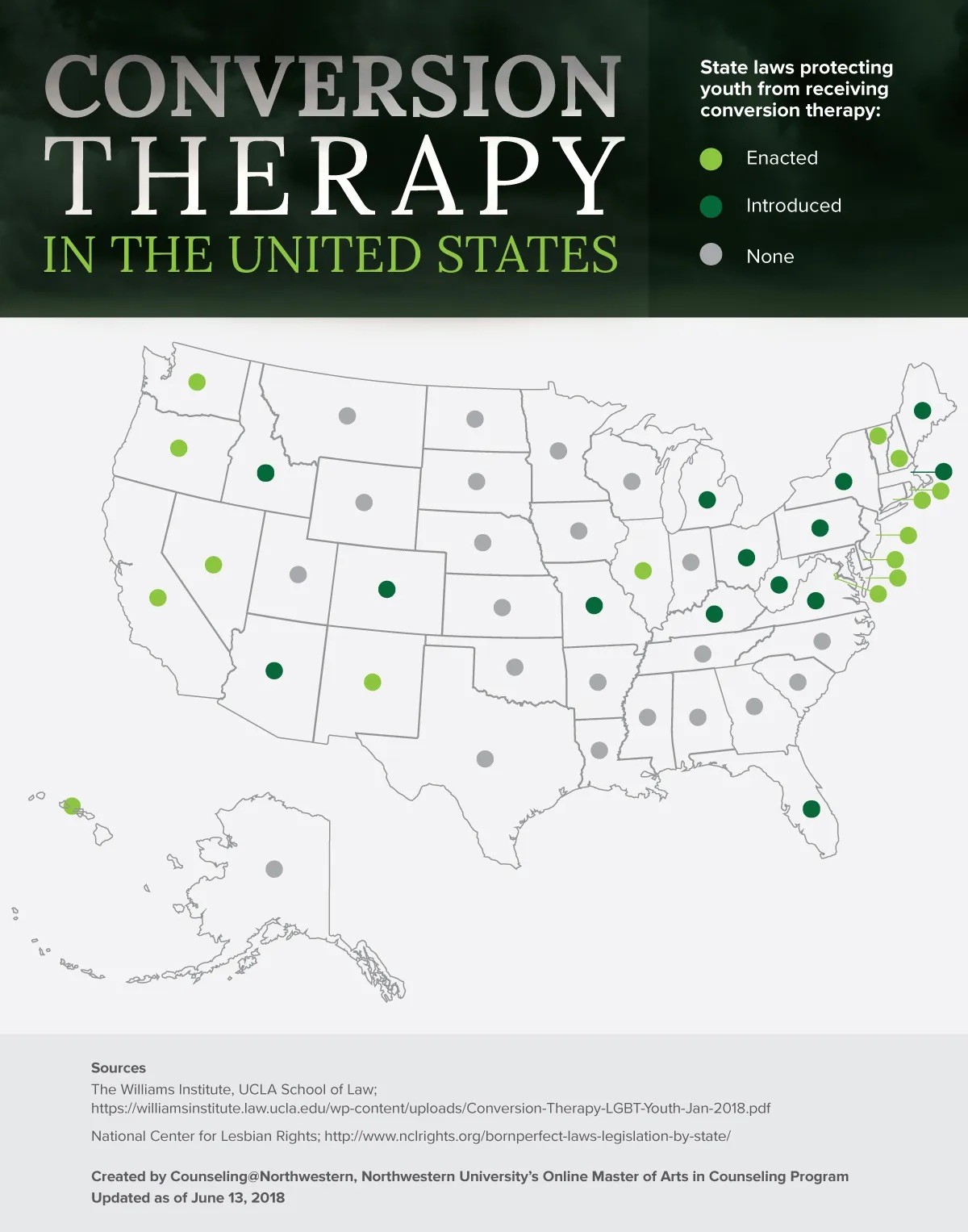
    Conversion therapy, broadly defined as any intervention that attempts to change a person's sexual orientation or gender identity, is now regulated by law in more than half of U.S. states. The pace of legislative action has accelerated significantly since California enacted the first state-level ban in 2012. As of early 2026, more than 23 states and the District of Columbia prohibit licensed mental health practitioners from administering conversion therapy to minors.


    The legal framework governing conversion therapy in the United States is fragmented. No federal statute bans the practice. State laws vary substantially in their definitions, scope, enforcement mechanisms, and the categories of providers they cover. Federal courts have reached conflicting conclusions about whether these laws are constitutionally permissible under the First Amendment, a split that has positioned the issue for potential Supreme Court review.


    This page provides a neutral, factual overview of the current legal landscape, the key court decisions that have shaped it, the constitutional questions that remain unresolved, and the gaps in existing law that advocates and policymakers have identified.

How Conversion Therapy is Defined in Law

One of the most consequential variables across state conversion therapy laws is how the practice is defined. Definitional choices determine who is covered, what conduct is prohibited, and how courts interpret the law when it is challenged.


Most state statutes define conversion therapy by its goal: an intervention that seeks to change a minor's sexual orientation, gender identity, or gender expression. Under this approach, the specific technique used is irrelevant to whether the prohibition applies. Colorado's law, for example, defines the practice as "any practice by a mental health care provider that seeks to change the sexual orientation or gender identity of a patient."


Some earlier statutes used more technique-specific definitions, listing specific methods such as aversive conditioning or behavioral techniques. Researchers and legal advocates have generally noted that technique-based definitions are easier to circumvent through rebranding, and that goal-based definitions are more durable. The Substance Abuse and Mental Health Services Administration (SAMHSA) recommended in its 2023 guidance that policymakers adopt functional, goal-based definitions for this reason.


A consistent feature across nearly all state bans is that they apply only to licensed mental health professionals. Pastoral counselors, clergy, and religious leaders are generally not covered by state licensing board jurisdiction, meaning that faith-based conversion efforts conducted outside a licensed clinical context are typically outside the scope of these laws. This is among the most frequently cited gaps in the current legal framework.

  • Federal vs State Jurisdiction

    Why There Is No Federal Ban

    As of early 2026, the United States has no federal law prohibiting conversion therapy. Legislative efforts to enact a federal ban have been introduced in multiple sessions of Congress but have not advanced to a floor vote. The most frequently reintroduced measure, the Therapeutic Fraud Prevention Act, frames conversion therapy as a deceptive commercial practice subject to Federal Trade Commission oversight rather than a direct clinical prohibition. The bill has been introduced in the 115th, 116th, and 117th Congresses without enactment.


    Federal agencies have issued guidance and policy statements opposing conversion therapy. SAMHSA's 2015 publication and 2023 report both formally concluded that the practice is harmful and should not be provided to minors. The Department of Health and Human Services has incorporated opposition to conversion therapy into broader LGBTQ+ health guidance. These positions carry policy weight but do not have the force of law.

    The Role of State Licensing Authority

    The primary legal mechanism through which states regulate conversion therapy is their authority over the licensure of mental health professionals. States have broad, well-established power to set conditions on professional practice as part of their police powers to protect public health and safety. This authority is the basis on which conversion therapy bans for licensed practitioners have generally been upheld as constitutional.


    The American Psychological Association and the American Psychiatric Association have each argued, including in amicus filings in conversion therapy litigation, that professional therapy is regulated medical and psychological conduct, not protected speech, and that states have the same authority to prohibit harmful conversion practices that they have to prohibit any other ineffective or dangerous clinical technique.


    The central constitutional dispute is whether that framing is correct or whether therapy, because it is delivered substantially through conversation, is better understood as speech entitled to First Amendment protection. Federal courts have split on this question, as detailed in the court cases section below.

    Medicaid and Federal Funding

    An additional federal dimension involves Medicaid reimbursement. Guidance from the Centers for Medicare and Medicaid Services (CMS) has clarified that conversion therapy is not a covered service under Medicaid. This means that in states that have not enacted a direct ban, a licensed provider who administers conversion therapy to a Medicaid-eligible minor cannot bill the federal-state Medicaid program for that service. The practical scope of this limitation is significant given that a substantial proportion of LGBTQ+ youth seeking mental health services are Medicaid-enrolled.

The Legal Landscape by State

The following reflects the state-level legal status of conversion therapy for minors as tracked by the Movement Advancement Project (MAP), a nonpartisan research organization that maintains the most widely cited database of LGBTQ+-related state legislation in the United States. Legislative status can change; readers should consult MAP's current tracker or state legislative databases for the most recent information.

States with Full Bans on Conversion Therapy for Minors

The following states and jurisdictions have enacted laws prohibiting licensed mental health practitioners from administering conversion therapy to patients under 18. Dates reflect the year of enactment.


California (2012): The first state to enact a ban. Senate Bill 1172, signed by Governor Jerry Brown on September 30, 2012, prohibited mental health providers licensed in California from performing SOCE on minors. Upheld by the Ninth Circuit in Pickup v. Brown (2013).


New Jersey (2013): The second state to enact a ban. Signed by Governor Chris Christie, who stated at the time that he believed the practice could cause serious harm. Upheld by the Third Circuit in King v. Governor of New Jersey (2014).


Illinois (2015): The Illinois Youth Mental Health Protection Act prohibits licensed professionals from engaging in SOCE with minors and is enforced through professional licensing discipline.


Oregon (2015): Oregon's ban covers licensed health care providers and is enforced through the Oregon Health Authority.


Vermont (2016): Vermont's ban applies to licensed mental health care providers.


New Mexico (2017): New Mexico's ban covers licensed counselors, social workers, and therapists.


Connecticut (2017): Connecticut enacted a ban applicable to licensed practitioners.


Nevada (2017): Nevada's ban applies to health care providers and is enforced through licensing board authority.


Rhode Island (2017): Rhode Island enacted a ban covering licensed mental health professionals.


Washington (2018): Washington's ban covers licensed behavioral health providers.


Hawaii (2018): Hawaii's ban applies to licensed health care professionals.


Maryland (2018): Maryland enacted a ban covering licensed mental health practitioners.


New Hampshire (2018): New Hampshire's ban covers licensed mental health professionals.


Delaware (2018): Delaware enacted a ban through professional licensing regulation.


New York (2019): New York's ban covers mental health practitioners licensed under the state's education law.


Colorado (2019): Colorado enacted a broadly worded goal-based ban. The law is currently the subject of Chiles v. Salazar, the most significant pending federal challenge to a state conversion therapy ban.


Massachusetts (2020): Massachusetts enacted a ban covering licensed mental health professionals.


Virginia (2020): Virginia's ban applies to licensed practitioners in the Commonwealth.


Utah (2020): Utah enacted a ban notable for its passage in a state with a large and politically influential religious community. The law was supported by a coalition that included members of The Church of Jesus Christ of Latter-day Saints.


New Mexico (2020 update): New Mexico strengthened its existing ban with additional enforcement provisions.


District of Columbia: The District of Columbia enacted a ban applicable to licensed mental health professionals.


Additional states including Minnesota, Michigan, Wisconsin, Pennsylvania, and others have introduced ban legislation in recent sessions without enactment as of early 2026. Current status for each state is maintained by the Movement Advancement Project.

States with Partial Bans or Limited Protections

Some states have enacted partial protections that apply to a subset of licensed providers or that are limited in scope. For example, some states' professional licensing boards have issued guidance or adopted rules prohibiting conversion therapy by specific licensee categories without a statewide statutory ban.

States with No Statewide Ban

As of early 2026, approximately 18 states have no statewide statutory ban on conversion therapy for minors. In several of these states, individual professional licensing boards have issued guidance discouraging or prohibiting the practice by their licensees, but without statewide legislative action, enforcement is inconsistent and the legal framework is uncertain.

States That Preempt Local Bans

A distinct category of states has enacted legislation that prohibits cities and counties from passing their own conversion therapy bans. This approach effectively blocks local governments in those states from providing protections that the state legislature has declined to enact. The legal and policy dimensions of this approach are discussed in the section on states that restrict local bans below.

How State Bans Work in Practice

Enforcement Mechanisms

State conversion therapy bans are typically enforced through professional licensing boards rather than through the criminal justice system. A licensed mental health provider who violates a state ban may face professional discipline including reprimand, suspension, or revocation of their license. Some states also authorize civil lawsuits by patients or their families against providers who violate the ban.

The licensing board enforcement model has several practical implications. Complaints must generally be initiated by the patient, the patient's family, or another party with standing to file a board complaint. Investigations can be lengthy. And because licensing boards have jurisdiction only over licensed practitioners, the enforcement mechanism does not reach unlicensed or religiously affiliated providers.

What State Bans Do and Do Not Cover

State bans consistently cover licensed mental health professionals, including licensed clinical social workers, licensed professional counselors, licensed marriage and family therapists, licensed psychologists, and licensed psychiatrists. They generally do not cover:


Religious or pastoral counselors who are not licensed mental health professionals. The First Amendment's protection of religious exercise and the Establishment Clause's limits on government regulation of religious practice have generally been understood to place pastoral counseling outside the reach of state licensing regulation.


Unlicensed lay counselors operating within religious communities. Even in states with bans, a church-based counselor who does not hold a professional license is not subject to licensing board authority.


Residential programs that are not licensed as mental health facilities. As the legal record in several states has shown, some residential programs have been structured to avoid triggering facility licensure requirements, placing them outside the regulatory reach of licensing-based bans.


Adults. Every state ban currently in force applies only to minors. No state has enacted a ban applicable to adult patients, and courts have been particularly skeptical of conversion therapy restrictions applied to consenting adults.
  • Key Federal Court Cases

    Pickup v. Brown, 9th Circuit (2013)

    Pickup v. Brown was the first federal appellate decision on the constitutionality of a state conversion therapy ban. The Ninth Circuit upheld California's Senate Bill 1172, ruling that the law regulated professional conduct rather than speech and that the state's authority to regulate licensed professionals extended to prohibiting harmful clinical practices regardless of whether those practices were delivered through conversation.


    The Ninth Circuit applied rational basis review, the most deferential level of constitutional scrutiny, finding that the state's evidence of harm associated with conversion therapy was sufficient to sustain the law. The court ruled that the law did not substantially burden protected speech because it applied only to conduct in the context of a licensed professional relationship.


    The full text of the decision is available through the Ninth Circuit's official records.

    King v. Governor of New Jersey, 3rd Circuit (2014)

    The Third Circuit upheld New Jersey's conversion therapy ban in King v. Governor of New Jersey, adopting a similar framework to the Ninth Circuit. The court held that the law regulated professional conduct and that the state's interest in protecting minors from harmful therapeutic practices was sufficient under rational basis review.


    The Third Circuit's decision applied a framework distinguishing between professional speech, which may be regulated by the state in its capacity as licensor, and public speech, which is entitled to full First Amendment protection. The court found that conversion therapy administered by a licensed professional to a minor patient fell within the category of regulable professional conduct.


    The decision is available through FindLaw's federal case database.

    Otto v. City of Boca Raton, 11th Circuit (2020)

    Otto v. City of Boca Raton represented a significant departure from the Ninth and Third Circuit frameworks. The Eleventh Circuit struck down local conversion therapy bans enacted by the City of Boca Raton and Palm Beach County, Florida, holding that the ordinances were unconstitutional restrictions on speech.


    The Eleventh Circuit rejected the professional conduct framing adopted by the other circuits, holding that because therapy is conducted substantially through talk, it constitutes speech and is entitled to First Amendment protection. The court applied heightened scrutiny rather than rational basis review and found that the bans did not survive that level of analysis.


    Judge Lagoa, writing for the majority, concluded that the professional relationship between a therapist and a patient does not strip the therapist's words of First Amendment protection. The decision created a direct circuit split with the Ninth and Third Circuits and significantly elevated the likelihood that the Supreme Court would need to resolve the constitutional question.


    The full decision is available through Justia's federal court database.

    The Circuit Split and Its Significance

    The conflicting holdings in Pickup, King, and Otto have produced a genuine circuit split on a significant constitutional question: whether state laws regulating the content of licensed therapists' communications with patients are subject to rational basis review as professional conduct regulation or to heightened First Amendment scrutiny as speech regulation.


    This split is significant not only for conversion therapy bans but for the broader category of professional speech regulation. Laws governing what licensed professionals may say to clients or patients, including laws regulating financial advice, medical informed consent, and attorney-client communications, could all be affected by the Supreme Court's resolution of the question.


    Legal scholars including Harvard Law professor Noah Feldman have observed that if the Court adopts the Eleventh Circuit's approach, it could destabilize a wide range of professional licensing regulations beyond conversion therapy. Northeastern University law professor Claudia Haupt, a specialist in professional speech, has written extensively on the doctrinal stakes of how the Court resolves this question.

Chiles v. Salazar and the Road to the Supreme Court

Background

Chiles v. Salazar is the federal case most widely identified as the likely vehicle for a definitive Supreme Court ruling on the constitutionality of state conversion therapy bans. The case challenges Colorado's 2019 ban on conversion therapy for minors by licensed mental health professionals.


The plaintiffs, represented by the Alliance Defending Freedom, include a licensed therapist who wishes to offer what they characterize as counseling to reduce same-sex attraction in minor clients consistent with their religious values. The core argument is that Colorado's ban unconstitutionally restricts the therapist's speech based on its content and viewpoint, in violation of the First Amendment.


Colorado's defense, supported by amicus briefs from organizations including the American Psychological Association, argues that the ban regulates professional conduct within a licensed therapeutic relationship, not protected speech, and that the state's well-documented interest in protecting minors from harmful and ineffective therapeutic practices provides sufficient justification for the law.

Procedural History

The case was decided at the district court level in favor of Colorado, with the district court applying the Ninth and Third Circuit professional conduct framework to uphold the ban. The Tenth Circuit affirmed, and the Alliance Defending Freedom sought certiorari from the Supreme Court.


The Supreme Court's handling of the petition has been closely watched by legal scholars, practitioners, and advocacy organizations on multiple sides. SCOTUSblog maintains a current case file for Chiles v. Salazar with updates on the petition's status.

The Constitutional Question

The central legal question in Chiles v. Salazar is whether a state law that prohibits a licensed therapist from delivering a specific type of counseling to a minor patient based on the content of what the therapist says regulates professional conduct or restricts protected speech.


If the Court rules that the law regulates conduct, rational basis review will likely apply, and the law will almost certainly be upheld given the substantial professional and scientific consensus that conversion therapy is ineffective and harmful.


If the Court rules that the law restricts speech, a higher level of scrutiny will apply, and the state will need to demonstrate a more compelling justification. Under heightened scrutiny, the outcome is less certain and depends substantially on how the Court evaluates the evidence of harm and the fit between the ban and its stated goals.


A third possibility is that the Court rules that professional speech is subject to an intermediate level of scrutiny, neither pure rational basis nor strict scrutiny, a framework that some legal scholars have proposed as a way to reconcile the competing interests at stake. Yale Law School professor Jack Balkin and others have written on the theoretical frameworks available to the Court in this area.

Implications for Existing State Bans

A Supreme Court ruling unfavorable to Colorado's ban would not automatically invalidate all state conversion therapy laws. It would, however, require courts reviewing challenges to other state bans to apply heightened scrutiny, and bans in states with weaker evidentiary records could be more vulnerable.


A ruling favorable to Colorado's ban would resolve the circuit split in favor of the professional conduct framework, providing a more secure constitutional foundation for the 23-plus existing state bans and likely encouraging additional states to enact legislation.

Amicus Participation

The case has attracted significant amicus participation. The American Psychological Association filed an amicus brief in support of Colorado's ban, arguing that the weight of the clinical evidence supports the state's determination that conversion therapy causes harm to minors. The brief is consistent with the APA's 2021 resolution formally opposing all sexual orientation and gender identity change efforts.


Several religious liberty organizations filed briefs in support of the plaintiffs, arguing that the ban improperly restricts counselors whose practice is informed by religious values.

  • Consumer Fraud as an Alternative Legal Theory

    Beyond professional licensing regulation, some states and localities have pursued conversion therapy providers under consumer protection and unfair trade practices statutes. This approach does not depend on characterizing therapy as professional conduct rather than speech. Instead, it targets the commercial representation of conversion therapy services as fraudulent or deceptive.

    Ferguson v. JONAH (New Jersey, 2015)

    The landmark case establishing conversion therapy's susceptibility to consumer fraud liability is Ferguson v. JONAH, decided in New Jersey in 2015. The Southern Poverty Law Center brought suit on behalf of several individuals against Jews Offering New Alternatives for Healing (JONAH), a conversion therapy organization, alleging that JONAH's marketing materials falsely represented that conversion therapy could change sexual orientation.


    A New Jersey jury found JONAH liable for consumer fraud, and the presiding judge ruled that it is a misrepresentation under New Jersey's Consumer Fraud Act to advertise or sell conversion therapy services on the basis that homosexuality is a disorder or that orientation change is achievable. The judge further ruled that offering "success statistics" for conversion therapy is itself fraudulent because "there is no factual basis for calculating such statistics."


    The scholarly analysis of the Ferguson v. JONAH verdict is documented in a 2016 article in the Northwestern University Law Review Online, which observed that the verdict "established that the fraud inherent in conversion therapy affects the entire class of individuals who purchase the service."

    The Consumer Fraud Framework's Advantages and Limitations

    The consumer fraud approach has several features that distinguish it from licensing-based regulation. It applies regardless of whether the provider is a licensed professional or an unlicensed operator. It focuses on the commercial representation of the service rather than on what the provider says during sessions, which may make it more durable under First Amendment scrutiny. And it can provide a damages remedy for individuals harmed by the practice.


    Its primary limitation is that it generally requires proof of a specific commercial transaction and a specific false representation, making it less suited to systematic prohibition and better suited to case-by-case litigation.

States that Restrict Local Bans

A distinct and somewhat counterintuitive category in the legal landscape consists of states that have enacted legislation prohibiting cities and counties from passing their own conversion therapy bans.


These laws, sometimes called preemption statutes, reflect a legislative determination at the state level to prevent local governments from enacting more protective policies than the state has chosen to adopt.


As of early 2026, several states, including Alabama, Georgia, Mississippi, and Tennessee, have enacted laws or taken other legislative action that restricts or prohibits local conversion therapy bans. The effect is that in these states, even municipalities with political majorities favoring a ban cannot enact one without state authorization.


Legal challenges to preemption statutes have generally been unsuccessful because states have broad authority to limit the regulatory powers of their political subdivisions. The Movement Advancement Project tracks preemption statutes as part of its comprehensive state-by-state database.

  • Gaps in Current Law

    Legal scholars, clinicians, and policy researchers have identified several recurring gaps in the current framework of conversion therapy regulation.

    The Unlicensed Provider Gap

    The most widely cited gap is that state licensing-based bans do not reach unlicensed providers. Faith-based counselors, lay ministers, and community accountability programs operating within religious organizations are generally outside the regulatory scope of professional licensing laws. The Williams Institute at UCLA has estimated that approximately three times as many minors are subjected to religion-based conversion efforts as to clinical ones, meaning that licensing-based bans may leave the most common form of the practice unregulated.

    The Residential Program Gap

    As noted above, some residential programs have been structured to avoid triggering facility licensure requirements. Programs that house minors in a structured, supervised environment and deliver what amounts to therapeutic programming may not meet the specific statutory definitions of mental health facilities in their states, placing them outside existing regulatory frameworks. Several states have introduced legislation specifically targeting residential programs.

    The Consent and Minors Gap

    Every state ban in force applies only to minors. The clinical and legal literature has noted the particular vulnerability of minors in the context of conversion therapy, since the decision to participate is typically made by parents rather than the young person. The APA's 2009 Task Force noted that the structural complications of consent in cases involving minors are among the reasons why conversion therapy for minors presents distinct concerns beyond those raised by the practice applied to consenting adults.

    The Interstate Commerce Gap

    When conversion therapy is offered across state lines, including through telehealth platforms, the question of which state's law applies becomes complex. A provider licensed in a state without a ban who delivers services via video to a minor in a state with a ban may be operating in a legal gray area, depending on how the applicable state laws are written and which state's licensing board has jurisdiction.

    The Rebranding Gap

    As documented in SAMHSA's 2023 report, some practitioners and organizations have sought to continue offering change-oriented services under new terminology as specific terms become legally restricted. Technique-specific statutory definitions are more vulnerable to this approach than goal-based definitions. Some states have responded by adopting functional definitions that define conversion therapy by its objective rather than its method.

The Legislative Outlook

Pending State Legislation

As of early 2026, legislation to ban conversion therapy for minors is pending in multiple states that have not yet enacted a ban. The states most commonly identified in legislative tracking as active sites of pending or recently introduced legislation include Michigan, Pennsylvania, Wisconsin, Minnesota, and Kansas.


The National Center for Lesbian Rights' Born Perfect campaign maintains a legislative tracker specific to conversion therapy ban efforts and has been among the primary organizations providing model legislation and legal support to states considering bans.

Potential Federal Action

Renewed federal legislative efforts are anticipated if and when the Supreme Court resolves the constitutional question in Chiles v. Salazar or a comparable case. A ruling that state bans are constitutionally permissible would likely encourage additional federal legislative efforts. A ruling that conversion therapy constitutes protected speech would complicate but not necessarily foreclose federal regulatory approaches, since a consumer fraud or commercial deception framing might survive even a speech-protective ruling.

The International Context as a Policy Reference

Several countries have enacted national criminal prohibitions on conversion therapy, providing comparative policy models for federal action in the United States. Canada's Bill C-4, which passed with unanimous support in both chambers of Parliament in 2021, criminalizes the practice, its advertising, and its commercialization. New Zealand's Conversion Practices Prohibition Legislation Act 2022 similarly applies criminal penalties to those who perform conversion practices causing serious harm.


The World Health Organization's 2023 report has called on all member states to end conversion therapy and has provided a framework analysis of the legal and public health mechanisms available to governments seeking to do so.

  • Frequently Asked Questions

    Is conversion therapy illegal in the United States?

    There is no federal law making conversion therapy illegal. Whether it is prohibited depends on the state and the setting. More than 23 states and the District of Columbia have enacted laws prohibiting licensed mental health practitioners from administering conversion therapy to minors.


    In states without such laws, the practice may still be addressed through professional licensing board discipline or, in some cases, consumer fraud statutes. Pastoral and religious counseling is generally not covered by any existing state ban. See the Movement Advancement Project's current tracker for state-by-state status.


    What is the difference between a state ban and a federal ban?

    A state ban applies only within the borders of that state and covers providers licensed by that state. A federal ban would apply nationwide to all providers subject to federal jurisdiction. As of early 2026, no federal ban has been enacted. Federal agency guidance opposing conversion therapy, including from SAMHSA and HHS, carries policy weight but does not have the legal force of a statutory prohibition.


    Do state bans apply to religious counselors?

    Generally, no. State conversion therapy bans are enforced through professional licensing authority and apply only to providers who hold a state mental health license. Clergy, pastoral counselors, and lay religious counselors who are not licensed mental health professionals are typically outside the scope of state licensing regulation. This is the most consistently cited gap in existing law.


    What is Chiles v. Salazar and why does it matter?

    Chiles v. Salazar is a federal case challenging Colorado's conversion therapy ban on First Amendment grounds. It is the most significant pending legal challenge to state conversion therapy laws.


    The case asks whether a state law that prohibits a licensed therapist from offering specific types of counseling to a minor based on the content of the therapist's communications regulates professional conduct or restricts constitutionally protected speech. The outcome will likely determine the constitutional durability of all existing state bans and affect the prospects for future legislation. SCOTUSblog maintains a current case file.


    Can a parent consent to conversion therapy for their minor child in a state with a ban?

    No. State bans prohibit licensed mental health practitioners from administering conversion therapy to minors regardless of parental consent. The bans are framed as restrictions on provider conduct, not on parental choice, and parental consent does not override the professional prohibition. Courts that have upheld state bans have consistently held that the state's interest in protecting minors from harmful therapeutic practices is sufficient to sustain the law even in the face of parental objection.


    What happens to a licensed therapist who violates a state ban?

    State bans are generally enforced through professional licensing boards. A licensed therapist who violates a ban may face disciplinary proceedings before the applicable licensing board, which can result in reprimand, probation, suspension, or revocation of the professional license. Some states also authorize civil actions by patients or their families. Violation of a conversion therapy ban is not a criminal offense under any current state law.


    Are there states where conversion therapy is actively protected by law?

    Some states have enacted preemption statutes that prevent local governments from enacting their own conversion therapy bans, effectively ensuring that local ordinances more protective than state law cannot be adopted. These laws do not affirmatively authorize conversion therapy; they simply limit local regulatory authority. No state has enacted a law affirmatively protecting the practice or prohibiting restrictions on it at the state level.


    Does the law cover online or telehealth delivery of conversion therapy?

    This is an unsettled area. Whether a state ban applies to services delivered via telehealth depends on how the law is written and which state's licensing board has jurisdiction over the provider. A provider licensed in a state without a ban who delivers telehealth services to a minor in a state with a ban may be operating in a legally ambiguous space. Several states are considering legislative language to address cross-border telehealth delivery explicitly.

Primary Sources and Further Reading

Legislative Trackers and Policy Databases

Federal Court Decisions

  • Pickup v. Brown, 740 F.3d 1208 (9th Cir. 2014). Available through Ninth Circuit Court of Appeals.

  • King v. Governor of New Jersey, 767 F.3d 216 (3d Cir. 2014). Available through FindLaw.

  • Otto v. City of Boca Raton, 981 F.3d 854 (11th Cir. 2020). Available through Justia.

  • Chiles v. Salazar: Current case status via SCOTUSblog.


State Legislation

Consumer Fraud Case


Federal Agency Guidance


International Legislation


Professional and Research Sources