Subscribe to the CT4F Newsletter to stay informed!
Sister Nancy Corcoran
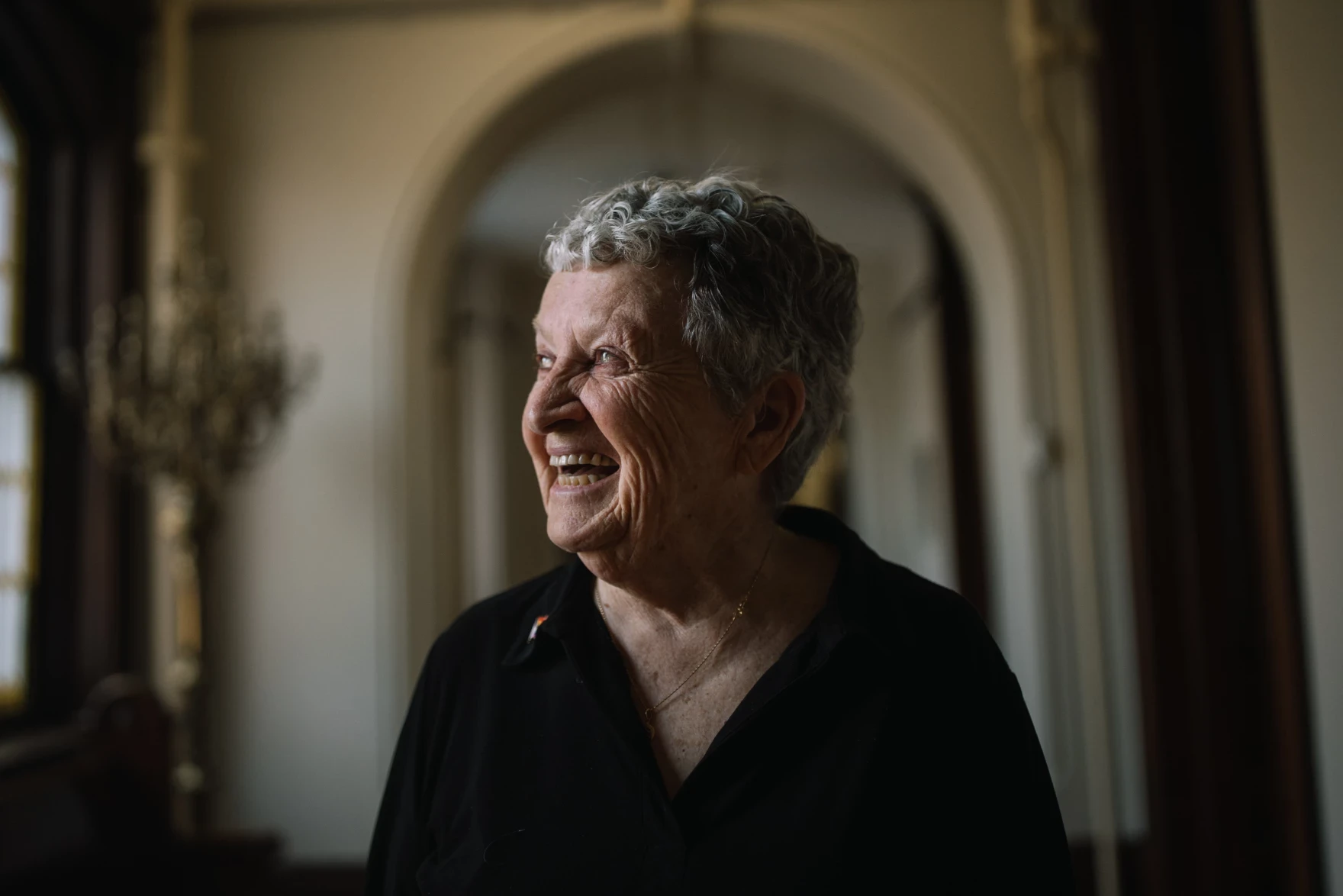
When most people picture a nun in deeply Catholic St. Louis, they don't picture a rainbow lawn sign reading "Save Trans Lives" propped outside the convent dining room. But that is exactly the sign Sister Nancy Corcoran placed at the entrance of the Sisters of St. Joseph of Carondelet motherhouse, and it is exactly the kind of unusual nun she has become.
At 81, after more than 50 years under vows, Corcoran has spent the last two years doing something almost no one else in her tradition is doing in her city: hosting affirming dinners for Catholic parents of transgender children, according to St. Louis Public Radio.
Snapshot of This True Story:
A lifelong nun and former Catholic school teacher, Sister Nancy Corcoran spent most of her life believing gender was a settled matter, until she decided she "needed to learn."
After meeting a transgender student about a decade ago, Corcoran took a two-year sabbatical to attend conferences and listen to trans people and their families.
She quietly began attending local TransParent support meetings, where, she says, she learned about unconditional love in a way she "never learned in the convent."
For two years, she has hosted affirming dinners at the motherhouse for Catholic parents of trans kids. There is no celibacy talk, no prayers that children stop being trans, just shared meals, faith, and stories.
Her meetings are deliberately affirming, a stark contrast to programs that promise to change a child, which every major medical body has rejected as ineffective and harmful.
Corcoran stood with more than 20 faith leaders as part of the LGBTQ+ Faith Alliance, declaring that all people are "beloved and created in the image of God, holy and whole."
For most of her life, Sister Nancy Corcoran considered gender a settled concept of men and women. Then, as a college instructor, she met a transgender student for the first time, and something cracked open. Nearing retirement, with the chance to take a sabbatical, she told herself plainly: "Nancy, you're blind and stupid in an area that is making a big difference to people's lives, and so you need to learn."
So she learned. She spent two years traveling to conferences and talking with trans people and their families. When she came back to St. Louis, the city where she had spent years teaching in Catholic schools, she didn't arrive with answers. She arrived with questions, and she sat down to listen.
The Lessons She Found at the Table
Corcoran started attending support meetings organized by the local chapter of TransParent, a group for parents of trans children. For the first several gatherings, she said nothing at all. She simply listened, wondering, "Why would people want a nun to come in and listen to these sacred stories?"
When she finally introduced herself, she described it as "a moment of grace." She told the parents she was a Roman Catholic nun and that she had learned so much from them. "I'd never learned about unconditional love in the convent," she recalled, "but going to the TransParent meetings, I learned about unconditional love."
One Catholic mother from that group later sought her out. The woman loved her church deeply and wanted to meet other Catholic parents who affirmed their children. That single request became the seed of the dinners Corcoran now hosts at the motherhouse, where about two dozen Catholic parents have gathered to share meals and talk about being Catholic, raising their families, and loving their kids exactly as they are.
Why "Affirming" Is the Whole Point
Corcoran is emphatic that her gatherings are affirming meetings. Unlike other Catholic support groups in the region, there is no talk of celibacy and no prayer that children will stop being trans or gay. That distinction is not a small one. It is the difference between care and harm, and the science here is not ambiguous.
Programs that aim to change a young person's sexual orientation or gender identity, a practice explained in depth here, have been rejected by every major American medical and mental health association, including the American Medical Association, the American Psychological Association, and the American Psychiatric Association. The practice is built on the false premise that being LGBTQ is, in the words of researchers at the Williams Institute, "abnormal, sinful, and should be rejected."
The consequences of that message are measurable. A landmark Williams Institute study found that LGBTQ people who underwent conversion therapy had nearly double the odds of lifetime suicidal ideation and 88% higher odds of attempting suicide than those who did not. The Trevor Project's research similarly found that LGBTQ youth subjected to these practices were more than twice as likely to attempt suicide, and more than 2.5 times as likely to report multiple attempts in a single year. A fuller summary of the mental health research tells the same story. Notably, the Williams Institute also reports that an estimated 81% of people who experienced conversion therapy received it from a religious leader, which is precisely why a nun choosing affirmation over "fixing" carries such weight.
What Corcoran offers instead is the thing the research keeps pointing back to as protective: acceptance. She tells the parents she ministers to that some of them will have to "take on the shame" that other people project onto their children. "They have to realize it is not about them, it's about their child," she said. "Do they want their child to become the best person that they can be, whoever that is, whether it's male or female?"
The Cost of Rejection and the Power of Acceptance
Corcoran's instinct toward affirmation is backed by decades of research on what happens inside families. The Family Acceptance Project at San Francisco State University, led by Dr. Caitlin Ryan, found that LGBT young adults who faced high levels of family rejection in adolescence were 8.4 times more likely to have attempted suicide and nearly six times more likely to report high levels of depression than peers who experienced little or no rejection.
The flip side is just as striking. Research shows that when a transgender young person is able to use their chosen name, severe depressive symptoms drop by more than 70% and suicide attempts fall by roughly 65%. Affirmation is not indulgence. It is, by every available measure, a protective factor against suicide.
This is the heartbreak that conversion-style teaching inflicts on the very families it claims to protect. As the Rev. Eli Anthony, a transgender assistant pastor who stood beside Corcoran at a public gathering, put it: teachings that don't affirm trans children "cause separation. It causes heartbreak. It causes suicide. It causes people to flee Missouri. It causes people to flee the church."
Standing Together in a Climate of Fear
The families Corcoran feeds are not living in the abstract. She describes a constant, grinding fear tied to repeated efforts by Missouri's legislature to restrict gender-affirming care, sports participation, and bathroom access. Some parents simply stopped coming to her dinners.
"I know 40 families who have already left the state. These are good, hardworking people," Corcoran said. "Every family of a trans child knows how long it will take to get across the river into Illinois, how long it would take to get to Canada, and, if they can afford it, they all have passports. That's the kind of terror that they live in."
On April 21, Corcoran joined more than 20 faith leaders in Tower Grove Park as part of the LGBTQ+ Faith Alliance, reading from a collective statement: "We declare all people are beloved and created in the image of God, holy and whole." Standing next to her was Pastor Anthony, who told the crowd he wanted transgender and nonbinary Missourians to know "that they belong here in Missouri. That they're loved and that love can be the loudest voice in the room."
Anthony knows that journey from the inside. He comes from a strict Catholic family, and it took five years before his own relatives came fully around. "They call me Eli, they use my pronouns," he said. He understands the fear that drives parents, who "want their kid to go to heaven, they want their kid to belong in this world," and he believes faith itself offers the way through it: leaning into trust, and into a God who is "so wholly just and so wholly loving."
A Faith That Can Still Change
What makes Corcoran's witness so powerful is that she has not left her church to do this work. She remains a nun in good standing, hosting these dinners in a century-old motherhouse, even though the gatherings are not endorsed by the Archdiocese of St. Louis. She holds onto hope that the church can grow, pointing to Archbishop Mitchell Rozanski's public reckoning with the archdiocese's history with slavery as proof that institutions can learn from their past and choose to do better.
"Yes, of course, the church will change," she said. "It always gets better."
It is a conviction this site hears again and again from the parents in our real stories, from Brandon Boulware, who got his smiling daughter back the moment he stopped trying to change her, to Paulette Trimmer, who learned that "faith would have chosen love." Sister Nancy Corcoran arrived at the same truth from inside the convent, one shared meal at a time.
Sister Nancy Corcoran set out to learn, and what she learned was that affirming a child is not a betrayal of faith but an expression of it. For Catholic parents who feel caught between their church and their child, her ministry offers a quiet, radical reassurance: you do not have to choose.
If you are a parent weighing what love requires of you, remember what the research and these families both keep saying. Rejection raises the risk of despair; acceptance protects against it. The most faithful thing you can do is also the most loving: to see your child as already beloved, holy and whole, exactly as they are.
Share Your Own Story
If this account resonated with you and you'd like to share your story, please feel free to share your own experiences surrounding conversion therapy in any capacity. We look forward to hearing your story.